
A Nation hires a new accountant at $58,000 because that is what the market required to fill the seat. Three doors down sits an accountant with eleven years of service earning $59,200. The gap between them is $1,200 for eleven years of loyalty. In a workplace where coworkers are also family and community, that math never stays secret.
What Is Pay Compression?
Pay compression is when the pay gap between new hires and experienced employees, or between supervisors and the people they supervise, shrinks so far that tenure and responsibility stop showing up in the paycheck. When a new hire actually passes a veteran, it is called inversion, and by then the damage is usually already walking out the door.
This article covers why compression happens, what it costs, three checks that find it, a worked example, and a fix that does not require an across-the-board raise. A compensation analysis toolkit at the end runs the checks on your own data.
Why It Happens, Even When Every Decision Was Reasonable
Compression is rarely the result of a bad decision. It is what reasonable decisions add up to when the structure underneath them stands still.
- Market rates for nurses, accountants, IT staff, and skilled trades moved sharply over the past several years, and starting offers moved with them.
- Long-tenured staff received cost-of-living raises that tracked inflation at best, while the market for their jobs outran it.
- Grant-funded positions carry salary caps that freeze pay regardless of what the structure says.
- Many Nations compete for the same people with their own enterprise, the Indian Health Service, and the county, each running a different pay scale.
- Promotions get priced as a percentage of the promoted employee’s old salary rather than against the new job’s range, so internal candidates start their new role already behind it.
- Salary ranges get set once and revisited rarely, so every new offer is priced against today’s market while every incumbent is priced against an old one.
What It Costs to Ignore
The first cost is the quiet resignation of your most experienced people, and in Tribal government that loss is bigger than a vacancy. Program history, funder relationships, audit memory, and community trust leave with them, and recruiting their replacement happens at the very market rate that caused the problem, so the Nation ends up paying the new-hire premium anyway, without the loyalty.
The second cost shows up when supervisors decline promotions because the added responsibility pays three percent more than the job they already have. The third is the grievance that lands in front of Council with two pay stubs attached, at which point the Nation is fixing compression on someone else’s timeline and in the worst possible setting.
Three Checks That Find It
None of these requires new software. All three are built into the companion toolkit.
- Compa-ratios by tenure. Compute each employee’s pay divided by their range midpoint, then group by years of service. New hires near 100% while ten-year employees sit below 95% in the same jobs is compression in one picture. Our compa-ratio guide covers the metric itself.
- Supervisor versus highest-paid direct report. Many structures aim for a differential of at least 10 to 15 percent between a supervisor and the people they manage; where the gap has closed to a few percent, promotions have stopped paying. Compute it as supervisor pay minus the highest direct report’s pay, divided by the direct report’s pay.
- The offer-versus-incumbent gate. Before any offer goes out, compare it to what current employees in that job earn. A simple standing rule, such as requiring HR director sign-off on any offer that lands above an incumbent with five or more years in the role, keeps new compression from entering the building.
A Worked Example
Here is what check one looks like in practice, for one job title.
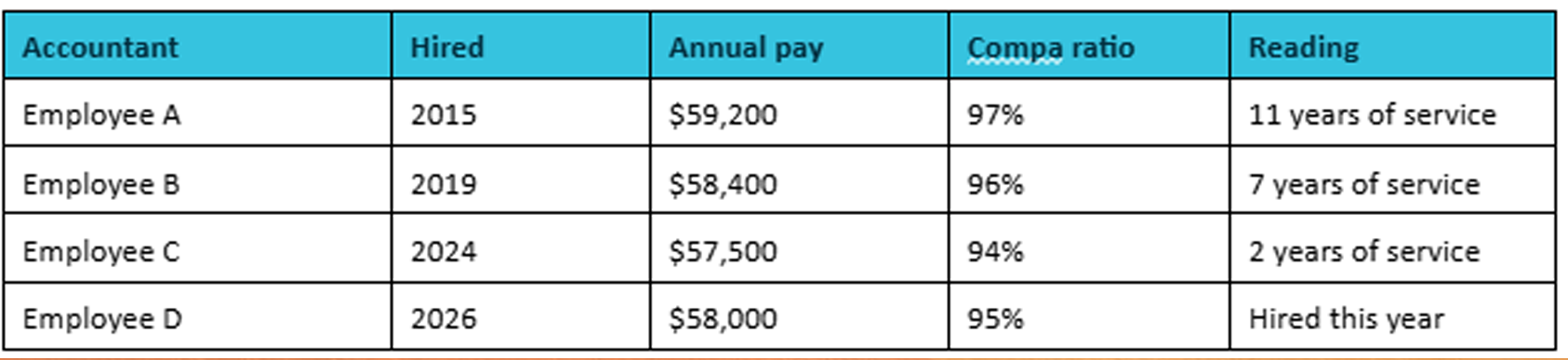
No single hire here was a mistake. Employee D’s offer matched the market. But the column tells every employee the same thing: staying does not pay. That is the finding an analyis documents, job by job.
Pay Compression Solutions That Do Not Break the Budget
Price it before you fear it. A compression analysis identifies the specific employees affected and what it costs to correct them. The number is almost always smaller than leadership expects, because the fix is targeted equity adjustments for the people compression actually touched, not an across-the-board raise. In the table above, restoring a modest tenure gradient for three employees costs a few thousand dollars, not a budget cycle.
Phase it if the single-year number is too heavy. A correction spread over two or three fiscal years, worst cases first, gives Council a plan it can approve instead of a problem it can only acknowledge. Vacancy savings and turnover often fund more of it than expected, and for grant-funded roles the adjustment can be written into the next budget period rather than forced into this one.
Then fix the structure so the problem does not grow back:
- Put salary ranges on a refresh schedule, benchmarked against the employers you actually lose people to, every two to three years.
- Adopt a compensation policy that moves employees through their range on tenure and performance, so position in range reflects service, not hire-date timing.
- Price promotions against the new job’s range, not the old salary.
- Keep the offer-versus-incumbent check in the hiring process permanently.
Finally, communicate it deliberately. Employees receiving adjustments should hear that the Nation reviewed pay and corrected inequities, not the details of anyone else’s check. Council should see the one-page version: who is affected by count, what it costs, how it phases. Council can defend a correction it can see.
Questions That Come Up in Every Compression Conversation
Would an across-the-board raise fix it?
No. Raising everyone by the same percentage moves the whole picture up and leaves every gap exactly where it was. It also costs far more than the targeted fix. Compression is a spacing problem, not a level problem.
Is this the same as a pay equity problem?
They overlap but differ. Compression is about tenure and role spacing. Equity questions compare pay across employees in like circumstances more broadly. A compression analysis will surface some equity findings along the way; treat those with the care and confidentiality they need.
How long does a compression analysis take?
For a Tribal government of a few hundred employees, the analysis itself is measured in weeks once three things are assembled: current pay, hire dates, and the salary structure. Assembling the data is usually the long pole.
Do we have to fix everything at once?
If it is not feasible, it is important to phase in adjustments by severity: those below minimum (80%), then tenure compression, phased across fiscal years with the plan on paper so employees can see it is real.
What data do we need to start?
A roster with employee information including job title, department, hire date, current pay, and supervisor, plus your pay ranges if they exist. The template is in the toolkit below.
The Pay Compression Analysis Toolkit
The toolkit runs all three checks. One tab compares longest-tenured employees against newest hires job by job and flags compression. Anyone who is below the minimum for their range. One prices the fix, with the adjustment for each affected employee phased across up to three fiscal years so the Council-ready total falls out the bottom. Sample rows show the format; replace them with your roster.
Download the Pay Compression Analysis Toolkit here.
Where Blue Stone Fits
Blue Stone Strategy Partners runs compression analysis and compensation studies for Tribal Nations, and hands Council documentation it can act on. If the accountant table above looked familiar, write to info@bluestonestrategy.com or call (949) 476-8828.