
When Congress passed the budget reconciliation law in July 2025, Tribal health advocates won a real fight. American Indian and Alaska Native beneficiaries were carved out of the new Medicaid work requirements. The cost-sharing exemptions for patients eligible through the Indian health system held. The IHS and Tribal encounter rate, the all-inclusive rate the federal government reimburses states at 100 percent, was left untouched.
That is the good news. It is also the reason a lot of Tribal health systems are about to walk into a problem they did not see coming.
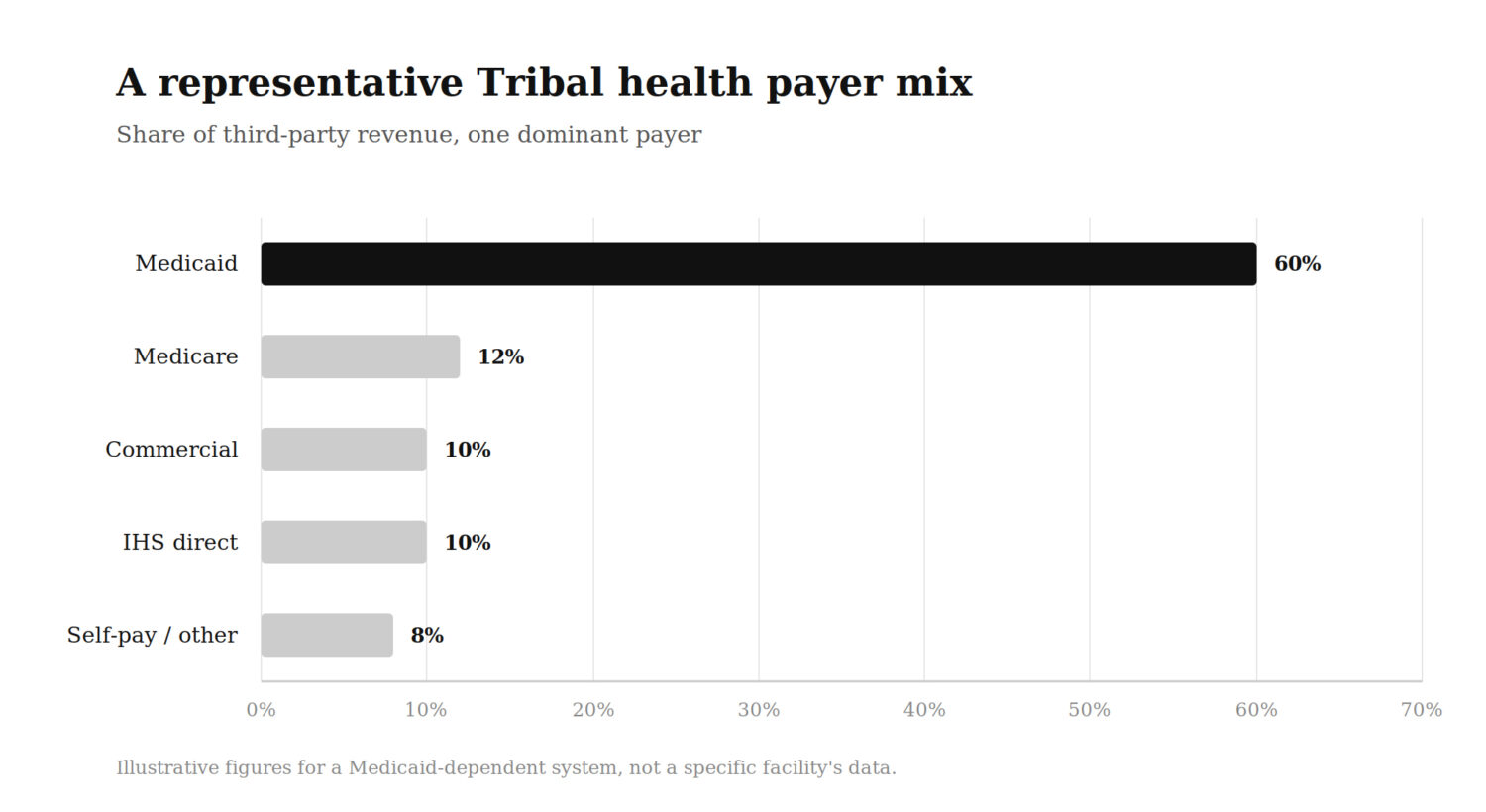
The protections won in 2025 guard the rate. They do not guard the volume. And for a Tribal health system that draws 60 percent or more of its budget from Medicaid, volume is the whole game.
The Cut You Can’t See on the Rate Sheet
Here is the mechanism, because it matters more than the headline.
The reconciliation law cut roughly $1 trillion in federal Medicaid spending over ten years. It did not do that by cutting what providers get paid per visit. It did it by shrinking the number of people who qualify and stay enrolled. Six-month redeterminations instead of annual. Shorter retroactive coverage windows. Work-requirement paperwork in the broader expansion population. The Congressional Budget Office estimates the Medicaid and CHIP provisions push 7.5 million people off coverage by 2034.
Tribal members are exempt from the requirements that drive most of that disenrollment. But exemption from a requirement is not the same as immunity from the result. A Tribal health system bills for encounters. When fewer of the patients walking through the door are enrolled in Medicaid, the encounter still happens, the care is still delivered, and the bill goes from a paid claim to uncompensated care. The rate per encounter never moved. The number of billable encounters did.
This is what makes the 2025 cut harder to manage than a rate cut would have been. A rate cut shows up on a spreadsheet the day it takes effect, and leadership reacts. Enrollment erosion shows up quarter by quarter, in a slow decline in the paid-claims mix, and by the time it is obvious in the financials, it has been underway for a year. There is no single bad day to point to. There is just a payer mix that quietly got worse.
Why a Sixty Percent Medicaid Base is a Reason to Diversify
Across Indian Country, Medicaid is the largest third-party payer for Tribal health programs. It can account for as much as 60 percent of a facility’s budget and about two-thirds of non-IHS revenue. That base was built for good reasons. Medicaid filled the gap left by an IHS funded at roughly half of identified need for decades. Billing Medicaid was the responsible move, and the Nations that learned to do it well built real operating capacity on top of it.
That capacity is also the foundation for the next step: adding revenue streams alongside Medicaid rather than relying on it alone. Blue Stone brings the same principle to health systems that it brings to economic development. A Tribal economy grows stronger when a second revenue engine runs beside the first, and health systems work the same way. The more of its payer mix a Nation controls, the more of its budget it controls.
The 2025 law shows why the timing matters. Congress moved $1 trillion out of the program without consulting Tribes. The protections Tribes had won held, and they mattered. Even so, Tribal systems will see the effects. The opportunity now is to pair those protections with revenue the Nation controls directly, so that the next change in Washington carries less weight.
The Demand Signal Hiding in the Closure Date
While Tribal systems absorb enrollment erosion, the regional market around them is losing capacity fast.
The Center for Healthcare Quality and Payment Reform counts 756 rural hospitals at risk of closure as of late 2025, more than 40 percent of them at immediate risk. A separate analysis from Chartis found that 46 percent of rural hospitals are running negative operating margins and 432 are vulnerable to closure, with 18 rural hospitals closing or dropping inpatient care in the past year alone. Rural labor and delivery units are disappearing faster than any other service line.
These closures are not random. Rural hospitals fail disproportionately because they carry a heavy public-payer mix in regions where Medicaid and Medicare reimburse below the cost of care, and they cannot cross-subsidize the losses. The 2025 Medicaid cuts will accelerate the trend by raising uncompensated care across the rural system.
For a Tribal Nation, this is the part worth sitting with. The same federal pressure that erodes a Medicaid-heavy Tribal revenue base is removing the competition and stranding patients across the surrounding region. Some of those stranded patients are commercially insured. A Tribal health system that has built capacity, holds self-governance authority over its workforce, and owns its facilities is one of the few entities in a rural region positioned to absorb that demand, and to bill it at commercial rates that run two to three times Medicare for outpatient specialty services.
The closure crisis is a demand signal. The question is whether a Tribal system is built to answer it or too exposed to take the risk
What the Strongest Nations are Doing Instead
The Nations that will come through the next few budget cycles in the strongest position are not the ones with the best Medicaid billing. They are the ones who started building a payer mix they control, while they still had the margin to invest in the transition. Four patterns show up repeatedly in our work.
They optimize the revenue they already have before they chase new revenue. Across multiple engagements, we have audited clinics that looked clean from the outside, with respected leadership, modern facilities, and engaged staff, yet were earning well below comparable facilities on net revenue per provider. The causes recur: 340B split-billing systems that misclassify eligible prescriptions and forfeit real pharmacy margin, claim denial rates running far above the 5-to-10-percent industry norm, commercial contracts left unrenegotiated for years, and a slice of delivered services that are never billed at all. Fixing the revenue cycle and the pharmacy program can lift net income substantially inside a year and a half, with no new service lines and no new patients. This is the highest-return, lowest-risk move on the board, and almost every system has a version of it sitting unaddressed.
They build service lines that bring in revenue they control. We have seen Nations carrying heavy IHS and Medicaid payer mixes stand up purpose-built hubs aimed at the regional market, in areas like specialty dental and integrative wellness, on a fee-for-service and commercial-insurance basis. The pattern that works keeps these hubs from displacing member services. They are net-new capacity, marketed regionally under a brand independent of the Nation’s name, competing on access and quality. Done well, this kind of expansion can move a service line from a marginal contributor to a multimillion-dollar one within a few years, with the majority of patients coming from off the reservation. Every one of those dollars is revenue that would not otherwise have entered the Nation’s economy, and almost none of it is exposed to a federal budget vote.
They use facilities as an asset, not just a cost. Nations with valuable real estate but limited clinical operating depth do not have to run specialty services directly to benefit from them. We have seen Tribes build or acquire medical real estate, retain ownership, and lease purpose-built suites to specialty operators on long-term triple-net leases with a revenue-share component. The result is predictable rental income plus a share of operator revenue, with the clinical performance risk sitting on the operators rather than the Nation, and the appreciating asset and the optionality to re-tenant or absorb operations later staying with the Nation.
They design facilities so federal reimbursement carries the cost. ISDEAA Section 105(l) requires IHS to lease Tribally owned facilities used for health services and reimburse the reasonable costs of carrying them. The strongest projects we have seen model the lease economics into new construction from day one, finance with tax-exempt bonds, and structure the lease so federal reimbursement covers the large majority of debt service, turning a facility from a capital burden into a self-carrying asset that expands capacity without draining reserves.
That last lever deserves a caution, and the strongest Tribal CFOs are already raising it. Section 105(l) reimbursement depends on a mandatory-appropriations obligation the federal government has fought repeatedly in court. The case law is strong right now. The Supreme Court’s 2024 decision in San Carlos Apache Tribe v. Becerra affirmed full-cost contract support, and the appellate posture on facility leases has never been more favorable. But a campus whose debt service depends 80 percent or more on 105(l) is making a long bet on a reimbursement stream that is mandatory today and contested in every appropriations cycle. The discipline is not to avoid the lever. It is to model what happens if the bet moves, and to build the operating margin that could absorb a gap. A Nation that diversifies its payer mix is also the Nation best positioned to carry a 105(l) facility through a disruption, because it is not relying on any single federal mechanism to stay solvent.
Sequence Matters More Than Ambition
None of this is an argument for reckless expansion, and it should not be confused with one. The order of operations is what separates the Nations that build durable health economies from the ones that overextend. Optimize what you already run. Build the governance that makes growth survive an election cycle. Then diversify, on top of a stabilized base, not in place of one.
Each step here follows that order. Optimizing the revenue cycle and 340B program is optimizing an asset the Nation already owns, which is why it comes first. Building commercial service lines is diversification done on top of a stabilized base, using self-governance authority the Nation already holds. The payer mix is the foundation. Everything else is built on whether that foundation can hold weight when one federal leg gets kicked out.
The Nations treating healthcare as a cost center will manage the 2025 cuts as a series of bad quarters they hope to reverse. The Nations treating healthcare as an economic engine will use this window, while reserves and Medicaid revenue are still healthy enough to fund the work, to build a revenue base that does not depend on the next budget vote. The difference between those two postures is not a policy outcome. It is a decision available to leadership right now.