In March, nearly 100 Tribal economic development leaders joined our session at the NCAIED Reservation Economic Summit for a 3-hour workshop on Tribal business expansion, optimization, and governance. Tribal Nations from every corner of Indian Country, ranging from Alaska to the Southeastern Seaboard, urban-adjacent and remote, gaming-anchored and resource-driven, mature operators and Nations still building their first major enterprise.
We asked them six questions in real time and watched the answers populate the screen. Like many of us, I thought Tribal economic development in 2026 to be a story dominated by new ventures, new asset classes, and new frontiers.
As answers and input from Tribal elected, enterprise, and economic development leaders from across Indian Country started to populate, a different story emerged.

They are choosing to focus on discipline and shoring up foundations over new endeavors.
After many Tribal portfolios rapidly expanded in the post-Covid era due to an influx of funding that built critical infrastructure and capacity, and an additional flurry of activity fueled by the uncertainty of a new, but familiar, federal administration, leaders are seeing that deliberate, intentional, and focused growth is the key to economic sovereignty. That type of growth isn’t possible without solidifying and modernizing the foundational pillars of Tribal economies. This is what we should start calling the foundation era for Tribal economic development. And it deserves to be understood on its own terms.
The Macro Context
The room did not arrive here by accident. Three forces have converged on Indian Country at the same time, and they are reshaping what growth actually means and where it should be focused in 2026.
The federal posture has shifted.
The federal pipeline that Tribal Nations have relied on for capacity, infrastructure, and program funding is narrower, less predictable, and less generous than it has been in generations. Programs that felt secure two years ago are being re-scoped. Agencies that responded quickly are now, at best, slower and oftentimes unstaffed, underfunded, or no longer in existence. The dollar amounts are changing, and so is the underlying assumption that the federal partnership will keep showing up the way it always has.
We have seen and survived this moment before. Each time, Indian Country has built through it. The Nations that thrived in past cycles were the ones that reduced federal dependence by investing in their own economies. The room at RES read the moment the same way.
The traditional Tribal revenue engines have matured.
Most Tribal economies are built on a narrow base of revenue drivers. Gaming most prominently, but also energy, natural resources, hospitality, federal contracting, and Tribally owned services. Whatever the mix, the structural picture is the same: a small number of engines doing a lot of work.
Those engines are all under simultaneous pressure. Market maturity in core categories. Commercial and state-level competition. Regulatory shifts. Secular changes in consumer behavior. And a broader regional economy, most often rural, sometimes single-industry, sometimes demographically thinning, that no longer offers the natural tailwinds it once did.
The point is not that any one of these industries is in trouble.

Future growth will have to come from optimizing what is already running and from carefully expanding the base. It will not come from riding the curve.
Capital is more expensive. And more selective.
Interest rates have not retreated to where construction pro formas were drawn five years ago. Construction costs themselves never fully receded from their post-pandemic peaks. And lenders and institutional investors are more discerning about Tribal credits than they were three years ago. As the lending environment grows more complex, and as more opportunities are emerging, capital providers are asking harder questions about governance, succession, separation of business and politics, and the predictability of the operating environment.
The implication is direct. New ventures are harder to capitalize and expensive to start and grow. Optimization of existing operations is the highest-return move on the board. And governance discipline is no longer just a community or political concern, it is now a requirement for accessing outside capital at all. Smart money follows smart governance.
Together, these three forces compress the playing field. They reward optimization, governance, and alignment. They punish unfocused expansion.
What the Room Told Us
We asked roughly 100 economic development leaders six questions during the summit. Their answers, taken together, do not read as a list of unrelated concerns. They read as a coherent strategic posture about barriers, concerns, and areas of focus across Indian Country.
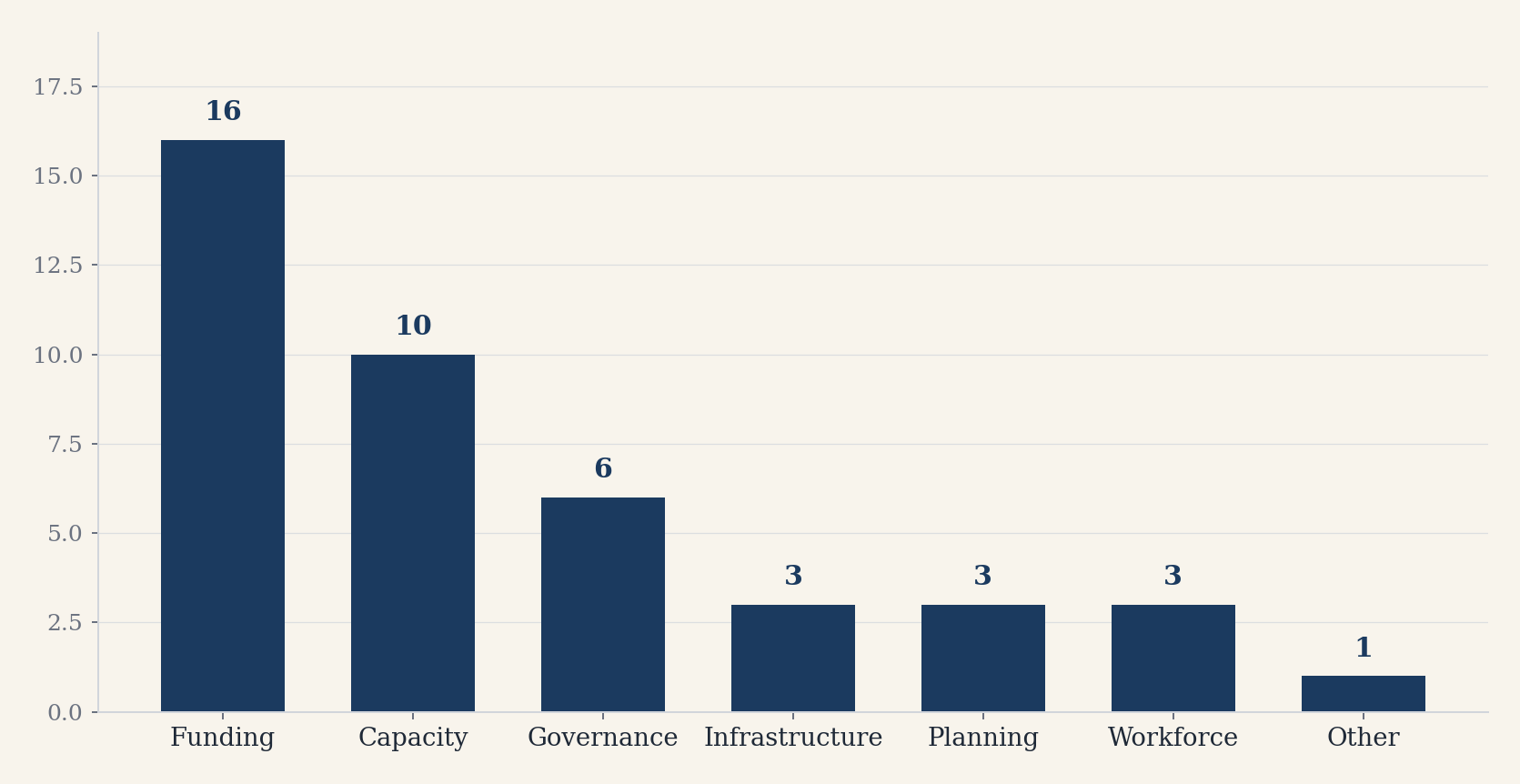
Participants selected one of seven categories representing common Tribal economic development barriers. Funding (16) and Capacity (10) emerged as the dominant hurdles, accounting for nearly two-thirds of all responses. Governance followed at 6, while infrastructure, planning, and workforce each registered modestly.
Theme 1. Foundations first.
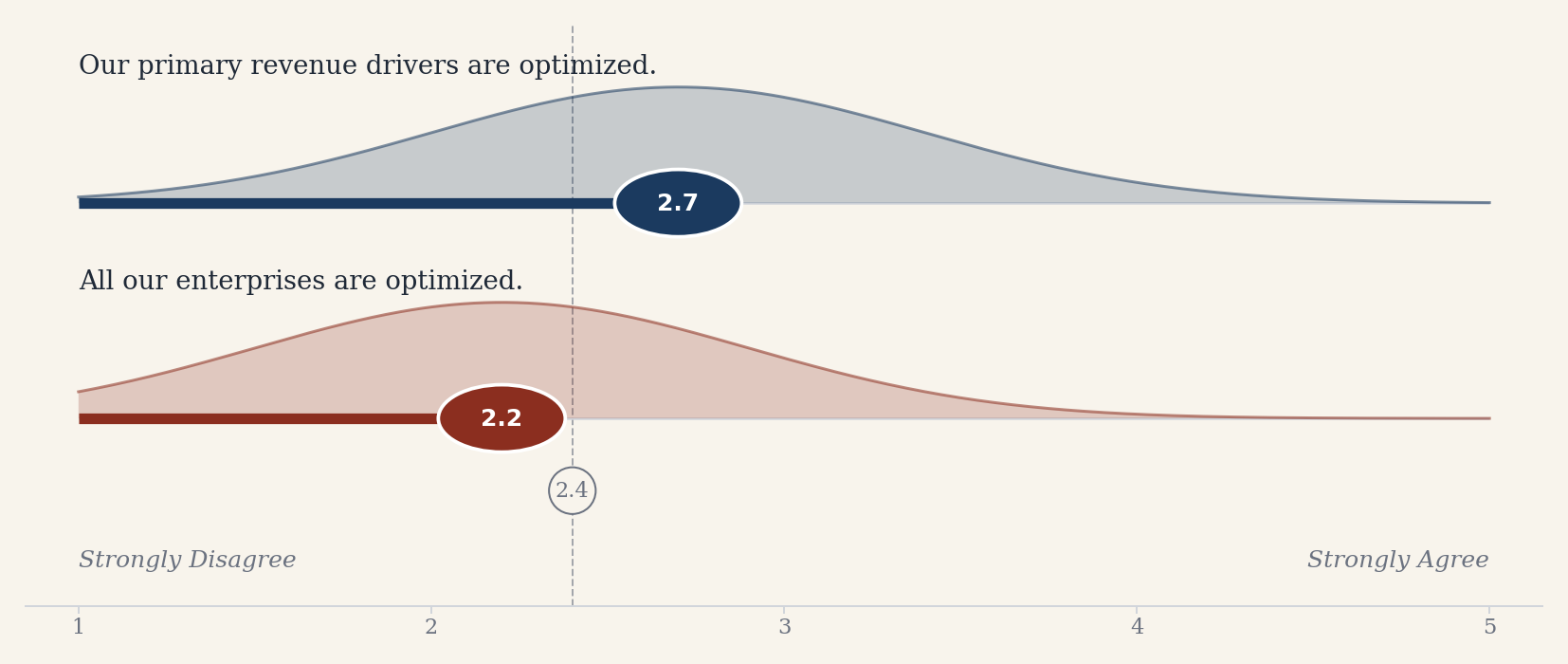
When we asked participants to rank their top priorities for the next 12 months, the order was unambiguous. Strategic planning ranked first. Governance reform ranked above launching new enterprises. Strengthening existing enterprises ranked higher than pursuing new ones. New enterprises ranked last.
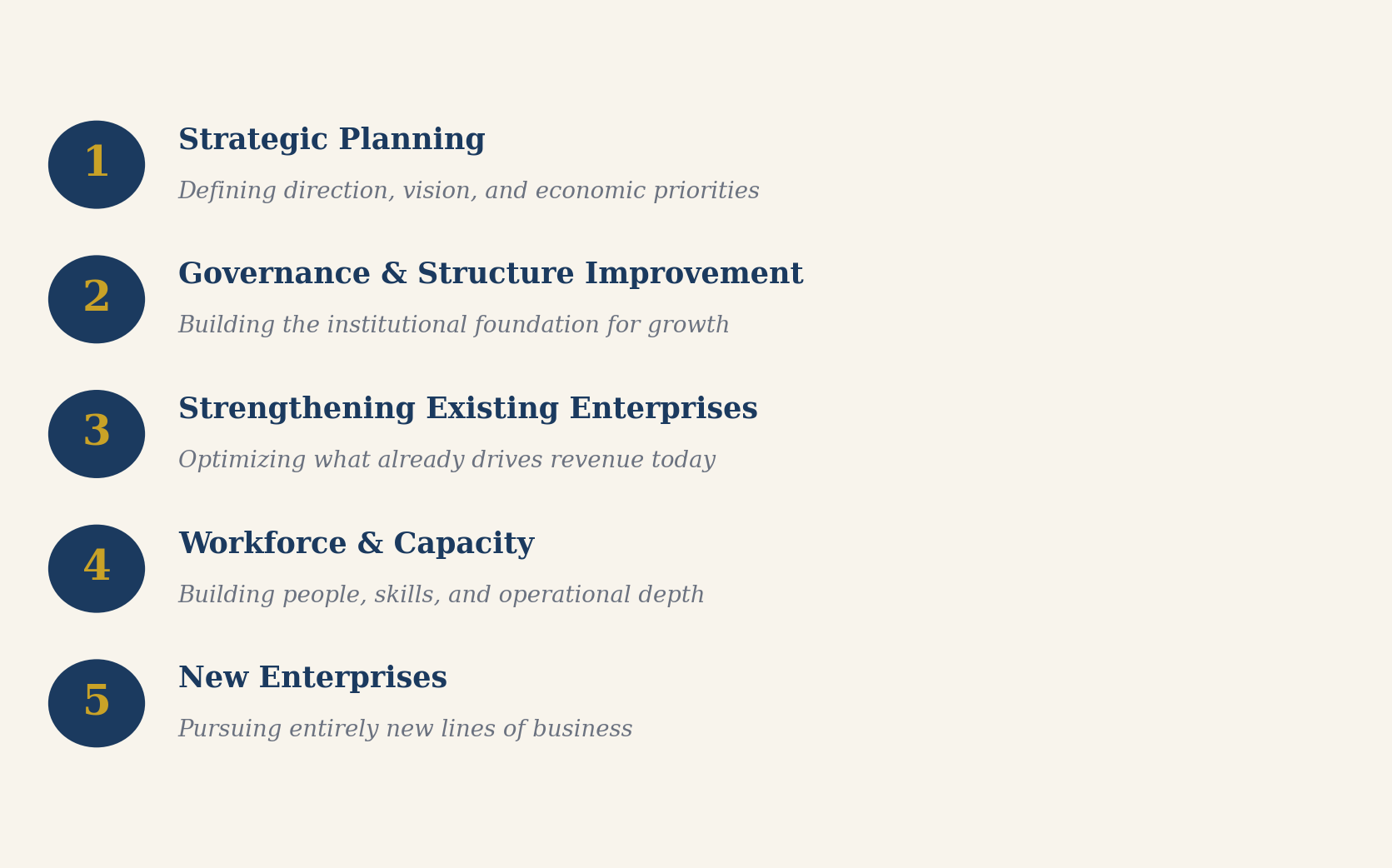
When we asked participants to assess how optimized their existing operations are, the aggregate average came in at 2.4 out of 5. Primary revenue drivers scored 2.7. The broader enterprise portfolio scored 2.2. These scores reflect the vision of leaders who know exactly where the work needs to be done.
And when we asked about diversification readiness, 64% of respondents reported that their Nation is still in the “learning” stage. Only a small handful reported that they are actively implementing.
Tribal Leaders are saying something important. Protect what works. Strengthen what is
underperforming. Do not chase a new line of business until you know what you have. In a higher-rate, lower-federal-funding, slower-growth environment, this is a valid strategic posture. It is not a posture of timidity; it is discipline.
Tribal Nations are not retreating. They are recognizing the importance of getting their houses in order before they build new wings.
Theme 2. Governance is the strategic lever.
Governance ranked third on the list of hurdles to economic growth, behind only Funding and Capacity. The governance story gets more interesting, though, when you look at where the gaps actually are.
We asked four questions about Tribal governance practices. Respondents were more likely to say that enterprises managing day-to-day decisions well (3.8) than any other governance question. In general, they were more likely to say they disagreed with the statements “enterprises are unaffected by election cycles” (2.4) and “Tribal Council focuses on long-term strategy” (2.4).
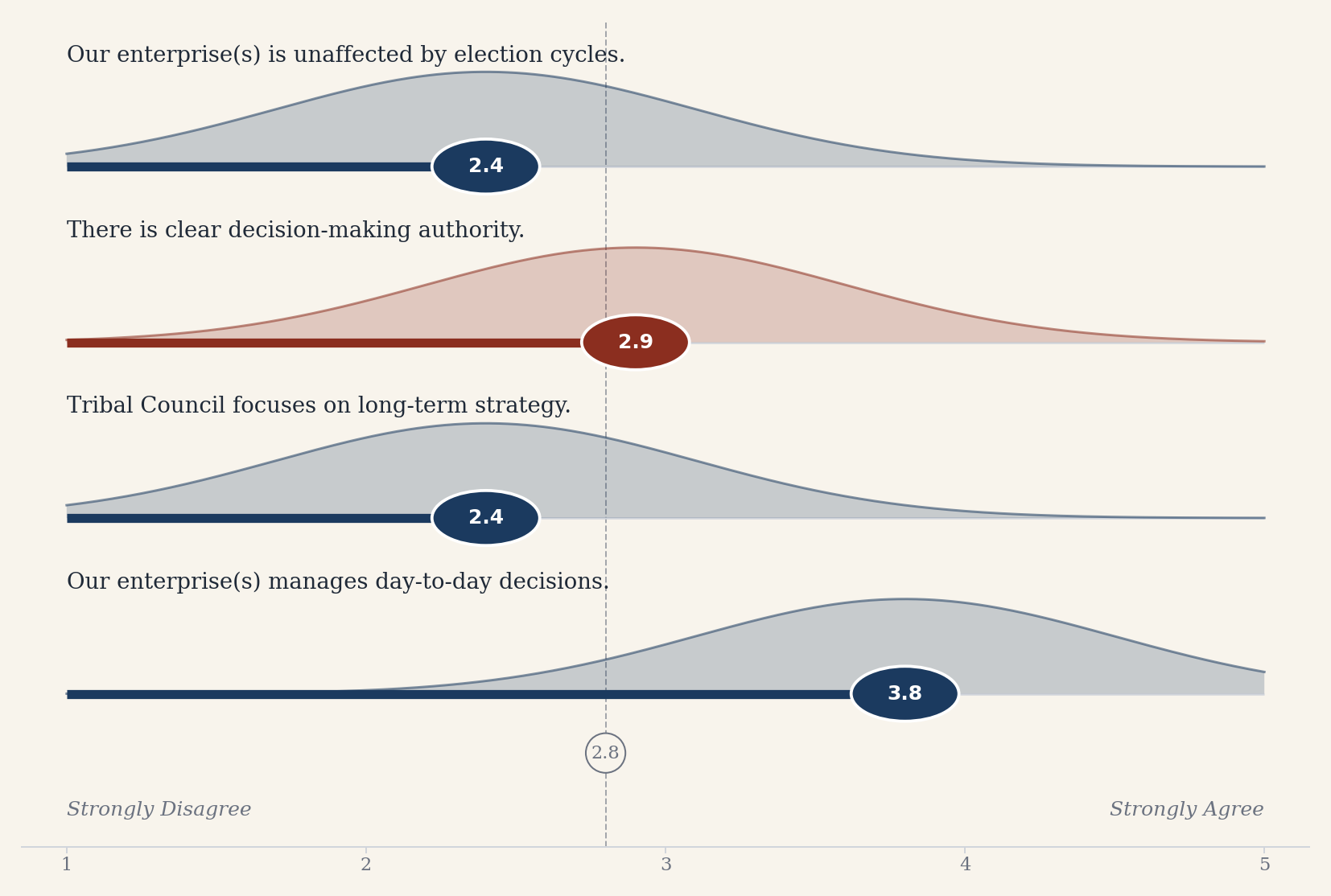
Operational competence is real. Enterprises know how to run a day. What is lagging is the structural separation between politics and businesses. This is the single most important governance reform on the table in Indian Country today, and the survey confirms what we have been hearing in client work for nearly two decades. Leaders know where the gap is, and in this foundation era of Tribal economic development, the work needs to be done to close it.
In a market where outside capital is more selective, the governance gap is no longer a community concern only. It is a balance-sheet concern. Capital will not deploy into jurisdictions where strategy can change with the next election. Strong governance is the precondition for diversification.
Tribal Nations are not asking how to add new businesses. They are asking how to build the governance structures that make new businesses possible and successful.
Theme 3. The alignment gap.
The quietest finding in the survey is also the most consequential.
When we asked participants to rate how aligned three groups — Tribal Council, enterprises, and Tribal members — are on the Nation’s economic vision, leadership and enterprises came in roughly together at 3.1 and 3.2 out of 5. Tribal member alignment scored 2.5.
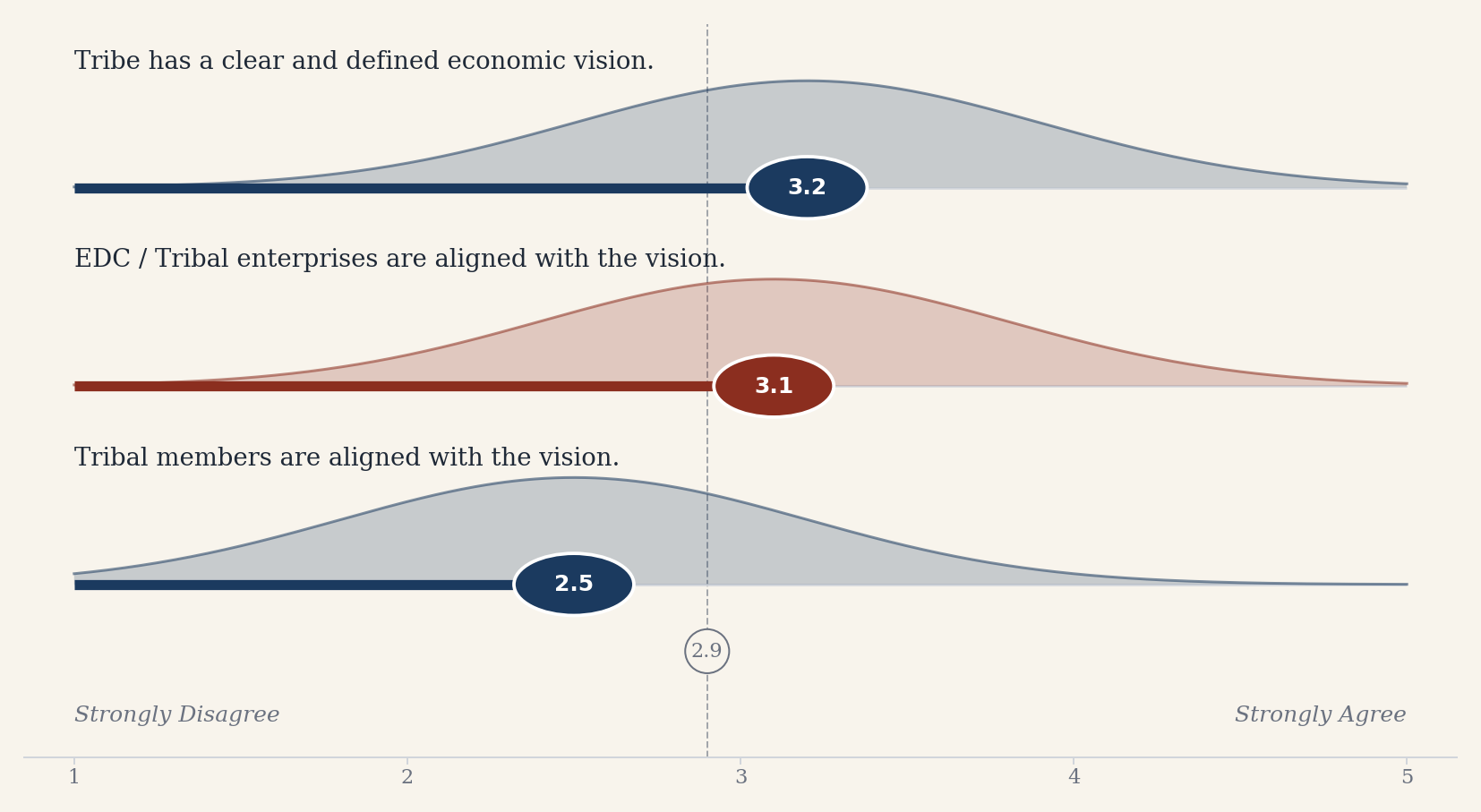
Participants responded that Leadership and enterprises roughly agree where the Nation is going economically. Their responses indicate the community is not fully on the same page.
This matters more than the headline scores suggest. Economic strategies that are not understood and supported by Tribal citizens do not survive an election cycle, a Council change, or a generational transition. A vision is not a poster on the wall. A vision is a shared mental model held by leadership, enterprise, and community simultaneously. When two of those three are aligned and the third is not, the strategy is structurally fragile, no matter how strong it looks on paper.
This is where governance and alignment converge. Insulation from election cycles only works if the community trusts the long-term strategy. Otherwise, insulation looks like distance, and distance does not last. The work of closing the alignment gap is not a communications exercise. It is a governance practice. Regular reporting. Transparent disclosure. Member engagement. A long-term plan that the community can hold leadership accountable to.
A Tribal economy that is aligned across leadership, enterprise, and community is more durable than any single revenue stream.
Three Priorities for the Foundation Era
The survey paints a picture. Here is what we believe the picture asks Tribal Nations and leaders to think about the year ahead.
Imperative 1. Optimize before you expand.
Most Tribal enterprises have meaningful margin, productivity, and customer-experience gains available to them right now within the businesses they already own. A 200-basis-point margin improvement on a mature, well-run enterprise is worth more than a new venture for the next five years, with a fraction of the execution risk and none of the capital outlay.
The right first question is not “what should we start?” It is “what are we leaving on the table in what we already run?”
Imperative 2. Build governance worthy of outside capital.
This is the longest list, and it is the most important. Separation of politics from day-to-day business operations. Tribal Council focused on long-term strategy and oversight rather than enterprise micromanagement. Defined business structures with clear charters, qualified boards, and real reporting lines, such as tribally chartered corporations, Section 17 corporations, and well-structured holding entities. Disclosure and transparency practices that signal to lenders and partners that the rules of the road will not change with the next election cycle or the one after that.
This is the work that unlocks every other ambition on the list. It is also the work that the room at RES has self-identified as the most important and the least addressed.
Imperative 3. Close the alignment gap.
Build a stated economic vision that leadership, enterprise, and community members can all describe in their own words. Treat Tribal member engagement as a governance function, not a communications function. Make alignment measurable. The survey instrument itself is a useful model, and many Nations would benefit from running a version of it at home.
If leadership and enterprise agree on the vision and the community does not, the strategy is one election away from being relitigated. Closing that gap is the single most underrated piece of work in Indian Country in 2026.
A note on diversification.
None of this is an argument against diversification. The appetite is there, and the survey is clear about it. The question is about sequencing. Optimization, governance, and alignment are not alternatives to diversification. They are the preconditions for diversification that actually and meaningfully work.
The Foundation Decade
The foundation decade is here, and Tribal Nations see it. What we heard at RES 2026 is that Tribal economies are not retreating, they are reforming. It is the kind of strategic patience and approach that builds sovereign economies that last. Economies that are not dependent on any single revenue engine, any single federal program, or any single political moment.
Blue Stone Strategy Partners is honored to be in this work alongside Tribal Nations wanting to invest in their foundation. We welcome the conversation about readiness, optimization, governance, and alignment for any Nation thinking through its roadmap for the year ahead.
The next great Tribal enterprise will not be launched from a press release. It will be earned through five years of disciplined work on the enterprises Tribal Nations already own, the governance structures that enable growth, and focused expansion that maximizes sovereign ownership and core capacity.